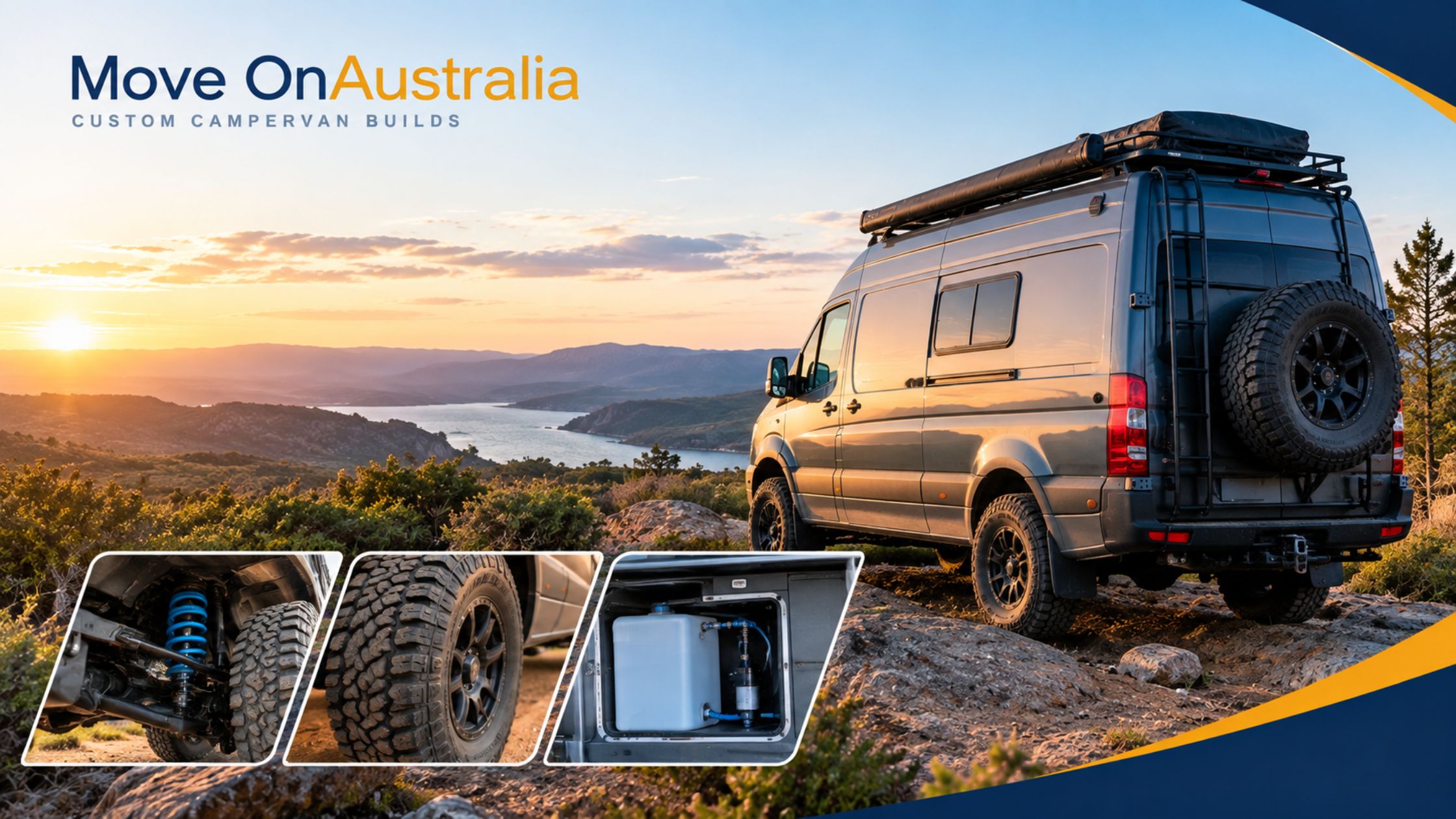
Not every campervan needs to handle corrugations, river crossings and a week without a refill point. But if you’re planning trips into the outback, up the Gibb River Road, or anywhere the bitumen runs out, your van needs to be built for it — not just painted to look the part.
This is the difference between a van that looks rugged and an overlander campervan that’s actually engineered for remote touring. In this guide, we’ll break down the three systems that matter most for serious off-grid travel: suspension, tyres, and water — and what to actually look for when you’re speccing an off road campervan in Australia.
Why factory suspension isn’t enough
Every van rolls off the factory line tuned for one thing: a predictable, empty vehicle on sealed roads. The moment you add a bed, cabinetry, a water tank, a battery bank and touring gear, you’ve changed the van’s weight distribution completely — and factory suspension wasn’t built to carry that extra load over rough terrain.
On corrugated roads, this shows up fast. A factory setup sags at the rear, loses ground clearance right when you need it most, and transmits every bump straight through to the cabin (and your gear). For genuine remote touring, most overlander campervan builds need:
- Heavy-duty springs and shocks rated for the van’s actual loaded weight, not its empty kerb weight
- A GVM (Gross Vehicle Mass) upgrade if your fit-out, water, batteries and gear push you close to or over the factory weight limit — this is a legal requirement, not optional
- Increased ground clearance to clear rocks, ruts and washouts without dragging the underbody
- Remote reservoir or upgraded shocks for long descents and repeated corrugations, which cause standard shocks to overheat and fade
The right setup isn’t about lifting the van as high as possible — it’s about matching the suspension to how the van will actually be loaded and driven. This is one of the reasons an experienced custom campervan builder will always ask about your intended terrain before speccing suspension, rather than fitting a generic upgrade.
Tyres: the upgrade that matters most
If you only upgrade one thing for off-road travel, make it your tyres. Suspension gets a lot of the attention, but tyre choice affects grip, puncture resistance, ride comfort and fuel economy more than almost anything else on the van.
For serious off road campervans in Australia, the general guidance is:
- All-terrain (A/T) tyres — the sensible middle ground for vans that split their time between sealed roads and gravel/dirt tracks. Quieter and longer-wearing than mud-terrain tyres, with solid grip on unsealed surfaces.
- Mud-terrain (M/T) tyres — better for genuinely rough, muddy or rocky conditions, but noisier and wear faster on bitumen. Worth it if you’re regularly tackling serious 4WD tracks.
- Load rating matters as much as tread pattern. A fully kitted-out campervan is heavier than the tyre size might suggest — underrated tyres are a common (and dangerous) oversight.
- Tyre pressure adjustment on the fly. Dropping pressure for sand or corrugated roads dramatically improves traction and comfort; a 12V compressor to re-inflate before you’re back on the highway is a non-negotiable inclusion.
A larger tyre and rim combination can also add ground clearance without a full suspension lift — but it needs to be engineered alongside the suspension setup, not bolted on separately, to stay compliant and safe.
Off-grid water: how much do you actually need?
Running out of water in remote Australia isn’t an inconvenience — it’s genuinely dangerous. Yet water systems are one of the most underplanned parts of a van build, often an afterthought compared to solar and electrical.
How much water should you carry? As a rough guide, comfortable daily use (drinking, cooking, basic washing) runs 20–30 litres per person per day. For a couple planning a week or two off-grid without guaranteed refill points, that means:
- 150–200L as a practical minimum for extended remote travel
- 300L+ for longer stints, or if you’re travelling with more people
- A mix of a fixed underslung tank plus portable jerry cans or bladders gives flexibility — you’re not stuck relying on one single point of failure
Filtration matters more than tank size Water quality varies hugely across Australia, especially from bore water, tank water at remote stations, or unknown sources. A proper off-grid setup typically includes:
- A twin filter system (sediment + carbon) for taste and general cleanliness when refilling
- A fine ceramic filter or UV sterilisation stage if you’re drawing from untreated or unknown water sources, to deal with pathogens standard filters won’t catch
- A grey water tank, which isn’t just about tidiness — many free camps and national parks now require self-contained grey water disposal, so it directly affects where you’re legally allowed to camp
Hot water and showers A diesel or gas hot water system paired with an internal or external shower setup makes remote travel genuinely comfortable rather than just survivable — worth factoring into the build from day one rather than retrofitting later.
Bringing it all together: what a genuine overlander build looks like
The theme across suspension, tyres and water is the same: off-grid capability isn’t one upgrade, it’s a system. A heavy-duty suspension setup means nothing if your tyres are underrated for the load. A huge water tank is dead weight if your suspension can’t handle carrying it over rough terrain. This is exactly why a bespoke campervan conversion — built around how you’ll actually use the van — outperforms a generic package build every time.
At Move On Australia, this is the thinking behind The Overlander, our purpose-built off-road campervan. Rather than bolting touring gear onto a standard van, every Overlander build starts with a conversation about where you’re actually planning to go — remote outback tracks, coastal 4WD access, long stretches between towns — and the suspension, tyres, water capacity and electrical system are specced to match.
As custom campervan builders with over 16 years and 600+ vans built, we’ve seen firsthand what holds up on Australian tracks and what doesn’t. If you’re serious about remote touring, it’s worth getting the fundamentals right before you spend a dollar on anything else.
FAQ
Do I need a GVM upgrade for an off-road campervan?
If your fully loaded van (water, batteries, gear, passengers) exceeds the factory Gross Vehicle Mass rating, yes — a GVM upgrade is a legal requirement, not just a performance improvement. Your builder should calculate this based on your actual build spec.
What tyres are best for an overlander campervan in Australia?
All-terrain tyres suit most touring builds that mix sealed and unsealed roads. Mud-terrain tyres offer more grip for serious off-road tracks but wear faster on bitumen and are noisier. Load rating matters as much as tread pattern for a fully kitted-out van.
How much water should an off-grid campervan carry?
As a guide, budget 20–30 litres per person per day for comfortable use. For extended remote travel, 150–200L is a practical minimum, with many serious overlanders carrying 300L or more split between fixed tanks and portable containers.
Is a suspension lift enough to make a van off-road capable?
No. Ground clearance is only one factor — load-rated tyres, correctly matched springs and shocks, and a GVM upgrade (if needed) all need to work together. An uncoordinated setup can actually make handling worse.
What’s the difference between an overlander campervan and a standard campervan conversion?
A standard conversion is generally built for sealed roads, caravan parks and shorter trips. An overlander campervan is built specifically for remote, off-grid travel — with upgraded suspension, off-road tyres, larger water capacity, filtration, and a bigger off-grid electrical system to support days or weeks away from services.
Thinking about building your own off-road-ready campervan? Talk to Move On Australia about The Overlander →